

Quick answer: To remove pet hair from carpet, loosen it first, then lift it. Mist lightly with a diluted fabric softener solution or sprinkle baking soda, wait five minutes, then work a rubber squeegee, damp rubber glove or carpet rake across the pile in one direction. Finish with slow, overlapping vacuum passes.
Anyone who shares a home with a shedding dog or cat knows the feeling: you vacuum a room until it looks spotless, then catch the light at a different angle and see a fine grey haze still woven through the fibres. Carpet doesn’t just collect fur, it grips it.
That’s not your vacuum failing. Pet hair has a barbed outer layer that hooks into looped and twisted carpet fibres, and dry indoor air adds a static charge that welds the two together. Suction alone pulls at the hair from above while the fibres hold on from below. Suction usually loses.
The fix is a two-stage approach used by professional wall to wall carpet technicians: break the bond first, then extract. This guide covers ten methods that do exactly that, which carpet types each one is safe on, the mistakes that quietly damage the pile, and a maintenance routine that keeps the problem from rebuilding.
Why Pet Hair Gets Stuck in Carpet?

Understanding the mechanism makes every method below more effective.
Three forces work against you:
- Static electricity. Dry air, especially in winter, builds a charge in synthetic fibres like nylon and polypropylene. Hair is attracted and held. Raising indoor humidity toward roughly 40% noticeably loosens its grip.
- Fibre structure. The cuticle scales on animal hair act like tiny barbs. In loop pile and twist pile sisal carpet, they catch and anchor.
- Foot traffic. Every step drives surface hair deeper into the pile, where standard vacuum suction can’t reach it.
10 Effective Methods to Remove Pet Hair from Carpet
1. Rubber Gloves – Best Free Method
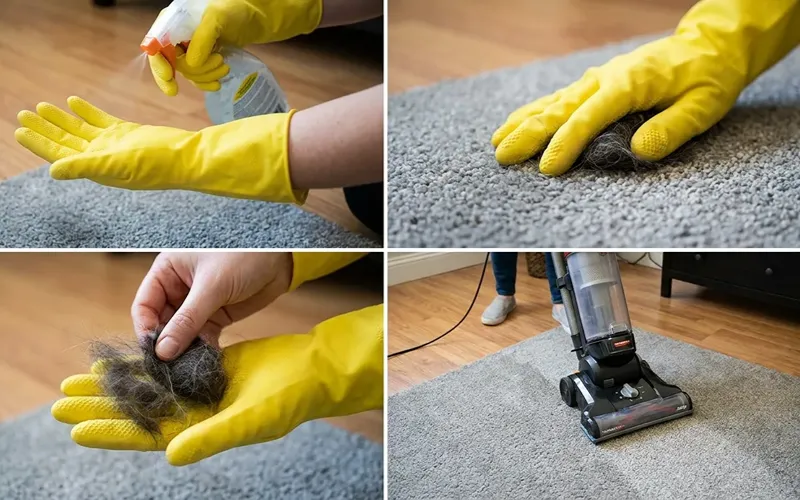
Ordinary dishwashing gloves are one of the most effective tools you already own. The textured grip bumps create friction and a mild static charge that rolls hair into collectable clumps.
Steps:
- Put on rubber or nitrile gloves and dampen the palms slightly, damp, not dripping.
- Run your hand across the living room carpet in short strokes, always in the same direction.
- Peel the accumulated clumps off and drop them into a bin bag as you go.
- Vacuum the area once you’ve worked across the whole surface.
Best for: low-pile carpet, area rugs, stairs, car footwells. Watch out for: wetting too heavily on wool, which can cause fibres to swell.
2. Rubber Squeegee – Fastest Manual Method
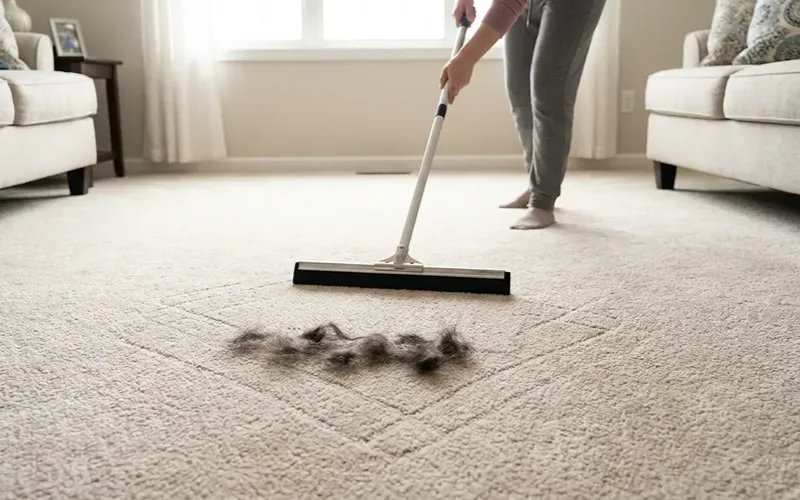
A window squeegee is a carpet rake in disguise. The soft rubber blade grips hair and drags it up without you having to crouch and scrub.
Steps:
- Start at one edge of the room and pull the squeegee toward you in overlapping strips.
- Apply moderate downward pressure so the blade reaches into the pile, not just across the tips.
- Gather the ridge of hair that forms at the end of each pass.
- Vacuum to collect the remainder.
Best for: every carpet type, this is the safest option on delicate pile. Watch out for: nothing significant. Rubber can’t snag fibres, which is why it’s the method to reach for when you’re unsure.
3. Carpet Rake – Best for Deeply Embedded Hair
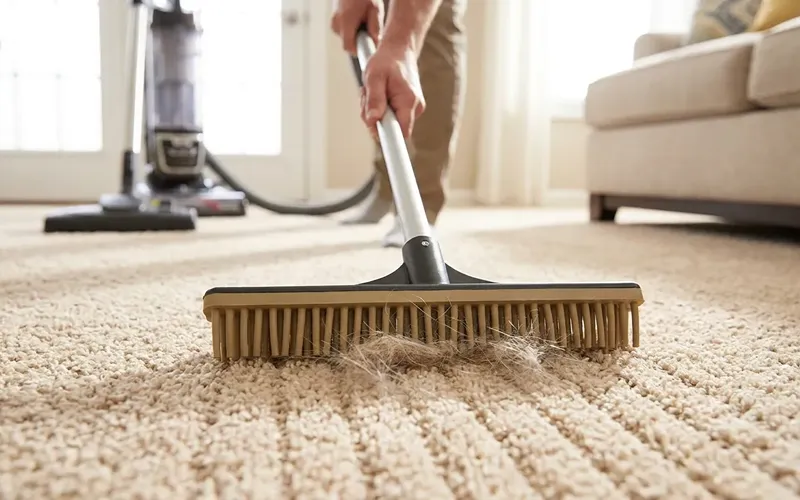
A carpet rake reaches hair that has been trodden down for months. Models come with rubber, silicone, plastic or metal bristles, and the choice matters more than most guides admit.
Steps:
- Choose rubber or silicone bristles for general use; reserve stiff plastic for dense, hard-wearing cut pile.
- Draw the rake toward you in straight overlapping lines with the bristles facing down.
- Clear the head every few passes.
- Vacuum afterwards to lift what the rake has brought to the surface.
Best for: thick cut pile, plush and saxony carpet. Watch out for: loop pile, Berber and twist pile carpet, raking these can pull loops and leave a permanently fuzzy, tatty finish. Skip to the squeegee instead.
4. Fabric Softener Spray – Best for Breaking Static

Fabric softener is designed to relax fibres and neutralise static charge, which is precisely the bond holding hair to your carpet.
Steps:
- Mix one part liquid fabric softener with three parts water in a spray bottle.
- Spot-test on a hidden area, a wardrobe floor or under a sofa, and let it dry fully to check for discolouration.
- Mist very lightly over the affected area. The carpet should feel barely damp, never wet.
- Wait 5-10 minutes until dry, then vacuum slowly.
Best for: synthetic carpet, especially nylon and polypropylene in dry winter conditions. Watch out for: wool and natural fibres, which react unpredictably to softener. Over-application leaves a residue that attracts dirt, so err on the side of too little.
5. Baking Soda – Best for Hair Plus Odour

Baking soda reduces static, gives the vacuum something granular to grab onto, and neutralises the lingering pet smell in the same pass.
Steps:
- Sprinkle a thin, even dusting across the affected area, a light snow, not a layer.
- Leave for 5 minutes to lift hair, or 15-20 minutes if odour is the bigger problem.
- Vacuum slowly with overlapping passes.
- Empty the canister immediately afterwards.
Best for: any carpet type, and especially favourite napping spots. Watch out for: heavy application clogging vacuum filters over time. Keep pets out of the room while it sits, and don’t use it on damp carpet, where it cakes.
6. Pet-Specific Vacuum – Best Overall Investment

Most vacuums fail at pet hair for structural reasons, not power ones: standard brush rolls tangle, filters clog, and wide floor heads smear hair rather than lifting it.
Steps:
- Vacuum in a grid, north-south across the room, then east-west. Hair is directional, and one pass only catches half of it.
- Move slowly. Speed is the most common reason vacuuming underperforms.
- Swap to the narrow hose or crevice attachment for edges and stairs, where concentrated suction pulls far harder.
- Empty the canister when it’s half full, not when it’s packed, airflow drops sharply before it looks full.
Best for: whole-home maintenance. Watch out for: anti-tangle or rubberised brush rolls are worth paying for. Hair wound around a standard beater bar strangles the motor within weeks.
7. Pumice Stone – Best for Matted Nap Spots

Where a cat or dog sleeps daily, hair compacts into a dense mat that no brush will shift. A pumice stone’s abrasive texture catches and rolls it out.
Steps:
- Test on an inconspicuous corner first.
- Rub gently in one direction with light pressure.
- Peel the collected fur off the stone and repeat.
- Vacuum the loosened hair.
Best for: low-pile and loop carpet, hard-matted patches, car interiors. Watch out for: pressing hard, which abrades fibre tips. Stop the moment you see loose fibre coming up with the hair.
8. Lint Roller – Best for Quick Touch-Ups

Extra-wide, long-handled lint rollers are made for floors rather than clothes, and they’re the right tool when guests are ten minutes away.
Steps:
- Roll over the visible hair in overlapping strokes.
- Peel off each spent sheet as it loses tack.
- Focus on stairs, rug edges and the strip in front of the sofa.
Best for: spot cleaning, stairs, small rugs. Watch out for: cost. This is a finishing tool, not a whole-room solution, an entire lounge will burn through a roll.
9. Balloon Static Trick – Best Zero-Cost Option

Rub an inflated balloon on a jumper, hold it just above the carpet, and static draws loose hair upward to the surface where a vacuum can reach it.
Steps:
- Charge the balloon by rubbing it against wool or hair for a few seconds.
- Sweep it a centimetre above the carpet.
- Wipe the balloon clean and recharge it.
- Vacuum the hair now sitting on the surface.
Best for: small patches, and getting children involved in the chore. Watch out for: it only lifts loose surface hair, not embedded fur. Pop and bin the balloon afterwards, burst latex is a genuine choking hazard for pets.
10. Professional Carpet Cleaning – Best Deep Reset

Hot water extraction reaches the backing of the carpet, pulling out hair, dander and dirt that surface methods leave behind. Most homes with pets benefit from this once or twice a year.
Steps:
- Vacuum and rake thoroughly first, professionals extract dirt, but loose hair should be removed beforehand.
- Book a technician who is WoolSafe-registered if you have wool carpet.
- Ventilate well and keep pets off until fully dry, usually 4–8 hours.
- Apply a carpet protector afterwards so hair sits on top of the fibres instead of binding into them.
Best for: annual deep cleaning, allergen reduction, end-of-tenancy situations. Watch out for: DIY rental machines over-wetting the carpet. Under-extraction leaves moisture in the underlay, which invites mould and odour.
Which Method Suits Your Carpet Type?
Matching the method to the pile is the difference between cleaning your carpet and slowly wearing it out.
| Carpet type | Safest methods | Avoid |
| Loop pile / Berber | Squeegee, rubber gloves, baking soda, vacuum with suction-only head | Carpet rakes, metal lint shavers, stiff bristles |
| Cut pile / plush / saxony | Carpet rake, squeegee, pet vacuum, fabric softener spray | Aggressive scrubbing that flattens the pile |
| Twist pile | Squeegee, gloves, vacuum | Rakes and stiff brushes, they cause permanent fuzzing |
| Wool | Squeegee, dry gloves, gentle vacuum, WoolSafe professional clean | Fabric softener, over-wetting, high heat, alkaline cleaners |
| Shag / high pile | Hands and gloves, vacuum with beater bar off, shake outdoors if it’s a rug | Metal shavers, pumice, anything that pulls loops |
| Sisal, jute, seagrass | Dry vacuuming only, soft brush | All moisture-based methods, natural fibres stain and shrink |
When in doubt, check the manufacturer’s care guide before trying anything abrasive or wet. A five-minute check protects a carpet you’ll live with for a decade.
Useful Cleaning Tips That Make Every Method Work Better
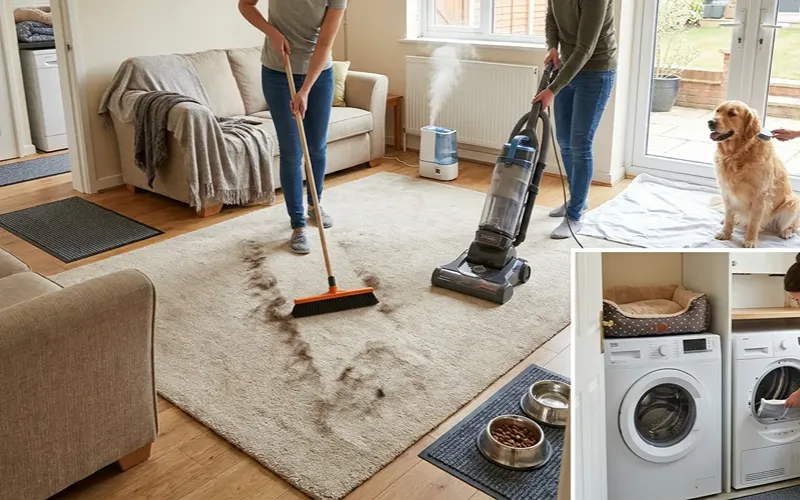
- Work in one direction. Random back-and-forth motion redistributes hair. Consistent strokes gather it into a collectable line.
- Vacuum in a cross-hatch pattern. Two passes at right angles pick up meaningfully more than four passes in the same direction.
- Slow down. Halving your vacuuming speed does more for results than doubling suction power.
- Raise the humidity. A humidifier or a bowl of water near a radiator cuts winter static, which is the root cause of the worst embedding.
- Groom the source. Three to five minutes of daily brushing for a double-coated breed removes more hair than any floor tool. Brush outdoors or over a washable sheet.
- Create catch zones. Washable runners at doorways, a blanket on the favourite sofa spot, and a mat under food bowls intercept fur before it reaches carpet.
- Wash pet bedding fortnightly on a hot cycle. Unwashed beds shed hair back into the room continuously.
- Tumble dry removable covers on a cold, no-heat cycle for ten minutes. The drum action shakes hair loose into the lint filter, clean the filter straight after.
Common Mistakes to Avoid
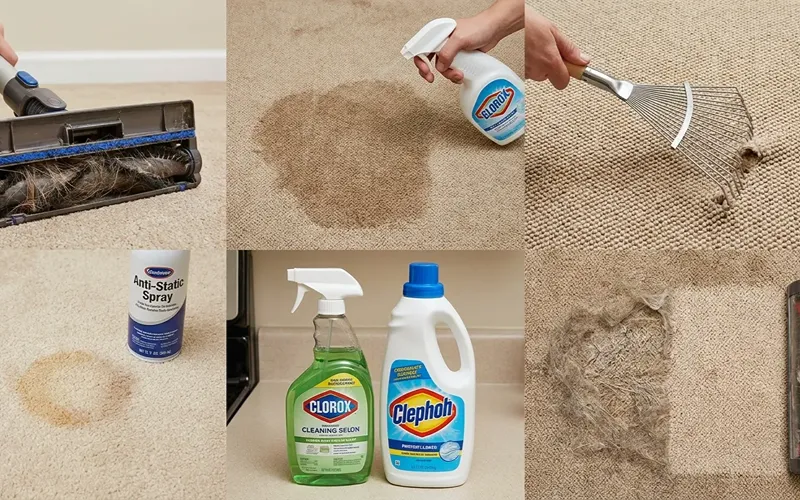
Vacuuming before loosening. The most common error. Suction can’t overcome static and barbed fibres on its own. Always break the bond first.
Soaking the carpet. Spray bottles are for misting. Saturated carpet takes days to dry through the underlay and can develop mould or a permanent musty smell, which is worse than the hair was.
Using a carpet rake on loop pile. This snags and pulls loops, creating fuzzy patches that never recover. The same applies to metal lint shavers on anything but low, tight pile.
Skipping the spot test. Fabric softener and anti-static sprays can discolour light carpet. Two minutes of testing prevents a permanent pale patch in the middle of your lounge.
Ignoring the vacuum itself. A tangled brush roll, clogged filter or overfull canister cuts performance dramatically. Cut hair off the brush roll monthly and wash filters as the manual directs.
Mixing cleaning products. Never combine bleach-based cleaners with ammonia-based ones. And keep pets out of any room where sprays or powders are in use until everything is dry and vacuumed up.
Waiting until it looks bad. Hair that has been walked into the pile for six weeks takes ten times the effort of hair vacuumed on day two.
A Simple Maintenance Routine
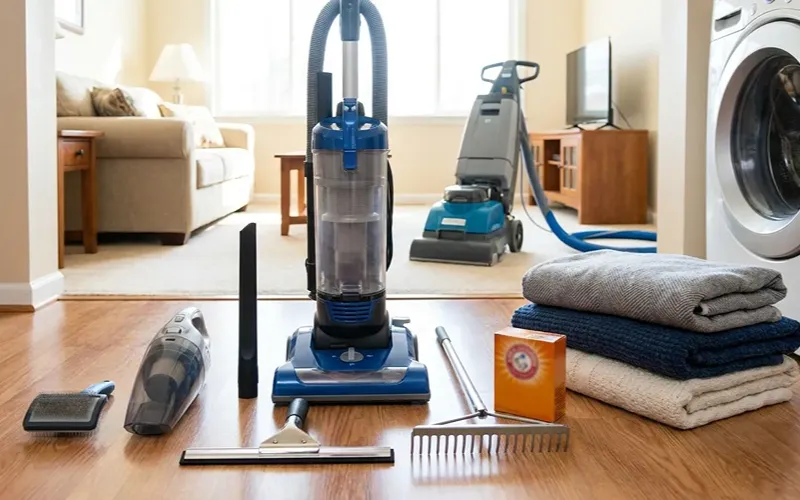
Consistency beats intensity. This schedule keeps most homes ahead of the shedding:
- Daily: brush your pet; quick vacuum or squeegee of the main traffic area and the pet’s favourite spot.
- Weekly: full cross-hatch vacuum of all carpeted rooms, including edges with the crevice tool; wash entrance runners.
- Fortnightly: hot-wash pet bedding; empty and rinse vacuum filters.
- Monthly: carpet rake or squeegee pass across whole rooms; baking soda treatment for odour; clear the brush roll.
- Twice yearly: professional hot water extraction, followed by carpet protector.
Conclusion
Knowing how to remove pet hair from carpet comes down to one idea: loosen the bond before you try to lift the hair. Static and barbed fibres are what defeat a vacuum, so break them first with a squeegee, damp gloves, a carpet rake, baking soda or a light fabric softener mist, then let the vacuum do the part it’s actually good at.
Match the method to your pile type, avoid the shortcuts that damage fibres, and build a short daily habit around grooming and quick passes. Do that, and the fur stops being a weekend project and becomes a five-minute background task, which leaves considerably more time for the animal that caused it.
Frequently Asked Questions
What is the fastest way to remove pet hair from carpet?
A rubber squeegee. It requires no preparation, no drying time and no special purchase, and it lifts embedded hair in a single pass across most carpet types.
Why won’t my vacuum pick up pet hair?
Usually three reasons at once: hair tangled around the brush roll, a clogged filter reducing airflow, and moving the vacuum too quickly. Clear the brush roll, wash the filter, and slow down before assuming you need a new machine.
Does baking soda really work on pet hair?
Yes, though indirectly. It reduces static and gives the vacuum a granular medium to grip, which improves pickup, and it neutralises odour at the same time. Use a thin layer and empty the canister afterwards.
Is fabric softener safe on carpet?
On synthetic carpet, diluted and lightly misted, generally yes, but always spot-test first. Avoid it on wool and natural fibres entirely.
How often should carpets be deep cleaned in a home with pets?
Every six to twelve months for most households, and closer to every six months for multi-pet homes or anyone in the house with allergies.
Can I remove pet hair without a vacuum?
Yes. A squeegee, rubber gloves and a lint roller together will clear a room, though you’ll be gathering the clumps by hand. It’s slower, but entirely workable.


